Doon Handicrafts

Lost Roman Weapons Found Near Dead Sea Cave

Ancient Swords Unearthed: Roman Weapons Found Near the Dead Sea Reveal Secrets of Empire and Rebellion

Rediscovering the Power of Roman Weapons Beneath the Desert Sands

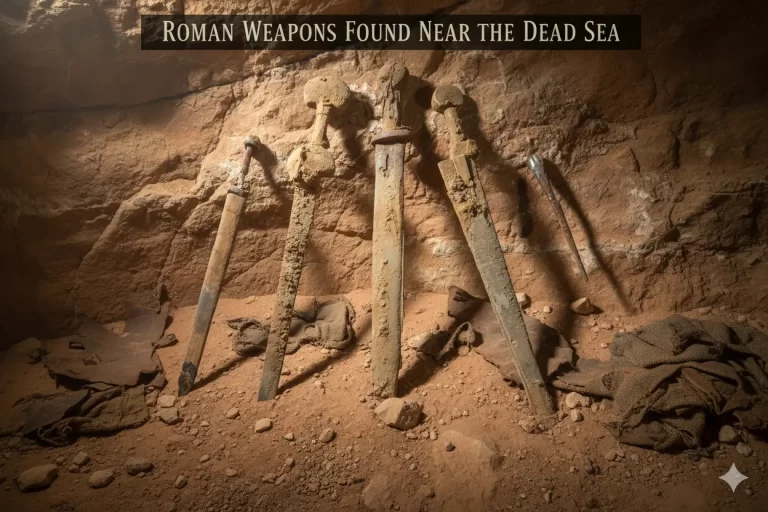
ancient bladesOnce again, archaeology discovered a hidden chapter of Roman history. Four superbly preserved Roman weapons, including swords from the second century CE, were discovered by archaeologists in a surprising discovery close to the Dead Sea.

These antique artifacts provide unique insight into the Roman military ranks, craftsmanship, and the violent clashes between Rome and Jewish rebels. They most likely belonged to troops stationed during the Bar Kokhba Revolt. Each blade stands as a symbol of conquest, perseverance, and the technological prowess that made the Roman army the most feared force of its time.

For historians and collectors alike, this find bridges the gap between legend and battlefield reality — revealing how ancient blades soldiers once wielded shaped both empires and rebellions.

Roman Weapons Weapons Roman

The Discovery: A Time Capsule from the 2nd Century CE

Four swords that were still in their leather scabbards were found by archaeologists from the Israel Antiquities Authority deep within a cave in the Judean Desert. These swords were remarkably well maintained for having lain unused for almost 1,900 years.

They are dated by experts to the Bar Kokhba Revolt (132–135 CE), in which Jewish freedom fighters battled against the military might of Rome. This is one of the best-preserved sets of Roman weapons ever discovered since the blades, wooden handles, and bindings were all preserved by the dry desert environment.

The discovery offers direct evidence of the actual combat use of swords during one of the most violent periods in ancient Judea.

Anatomy of the Roman Swords: Precision Meets Power

The swords discovered near the Dead Sea are all variants of the Roman Spatha — longer than the traditional gladius, these blades measured between 60–65 cm. The spatha symbolized Rome’s evolving warfare tactics and adaptability across its vast empire.

1. The Blade – Strength and Reach

The Roman Spatha has a double-edged iron blade that was made using advance metalworking methods. The longer range gave Rome’s armies more tactical adaptability by enabling soldiers to attack successfully from horseback.

2. The Hilt and Crossguard – Designed for Command

These weapons’ wood-crafted hilts provide excellent grip and control. Roman engineering, which placed a strong emphasis on control and accuracy, is known for its elegant crossguard, which protected the hand in close combat.

3. The Scabbards – Function and Rank

The leather scabbards, surprisingly well-preserved, indicate the weapons belonged to trained Roman soldiers or officers. Scabbards often displayed intricate designs to represent Roman Military Ranks, rank, and discipline within the legion.

Roman Military Ranks and Their Weapons

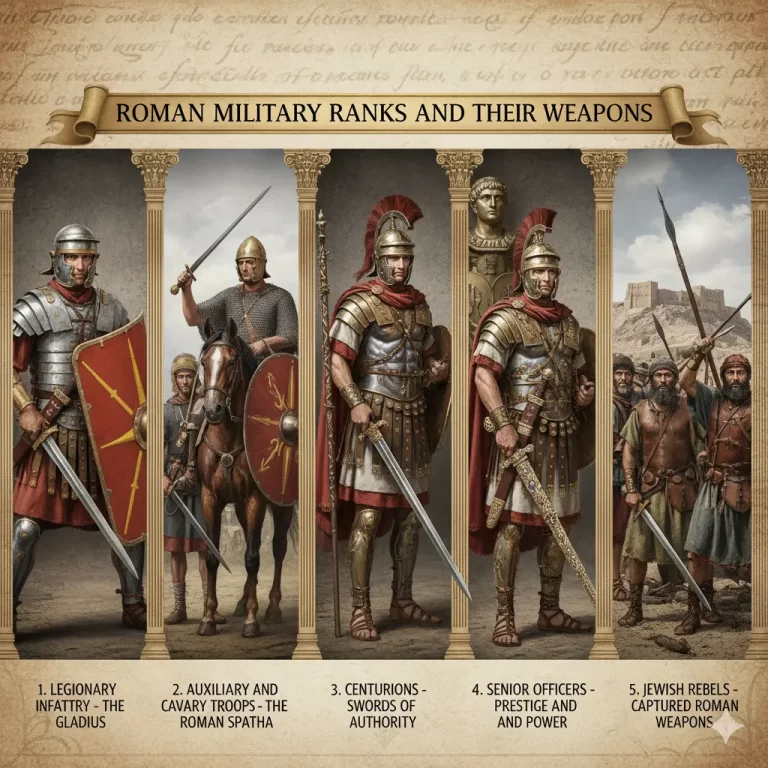
Understanding who used which Weapons reveals the disciplined structure behind Rome’s unstoppable military machine. Every rank carried a distinct weapon suited to their battlefield role.

1. Legionary Infantry – The Gladius

At the core of the Roman army were the legionaries, equipped with the gladius, a short stabbing sword designed for close combat in tight formations.

  • Primary weapon: Gladius Hispaniensis

  • Secondary gear: Pilum (javelin), scutum (shield)

  • Rank example: Miles (common soldier)

2. Auxiliary and Cavalry Troops – The Roman Spatha

Cavalry units and auxiliary soldiers used the longer Spatha, perfect for mounted combat and slashing attacks. These Weapons were the backbone of mobile warfare.

  • Primary weapon: Roman Spatha

  • Secondary gear: Hasta (spear)

  • Rank example: Ala cavalryman or Auxilia trooper

3. Centurions – Swords of Authority

Centurions, the commanding officers of roughly 80 men, carried decorative swords symbolizing leadership. Often personalized, these Weapons were both functional and ceremonial.

  • Primary weapon: Ornate short sword

  • Secondary gear: Vine staff (vitis)

  • Rank example: Centurio

4. Senior Officers – Prestige and Power

Higher-ranking officers such as tribunes and legates carried finely decorated Swords to reflect prestige rather than for daily combat.

  • Primary weapon: Parade spatha or dagger (pugio)

  • Rank example: Legatus, Tribunus, Praefectus

5. Jewish Rebels – Captured Roman Weapons

During the revolt, Jewish fighters often captured Roman swords and spathae, reusing them against the empire. This adaptation reflected both desperation and ingenuity — a fight for freedom fought with the empire’s own blades.

Historical Context: The Bar Kokhba Revolt and the Fall of Judea

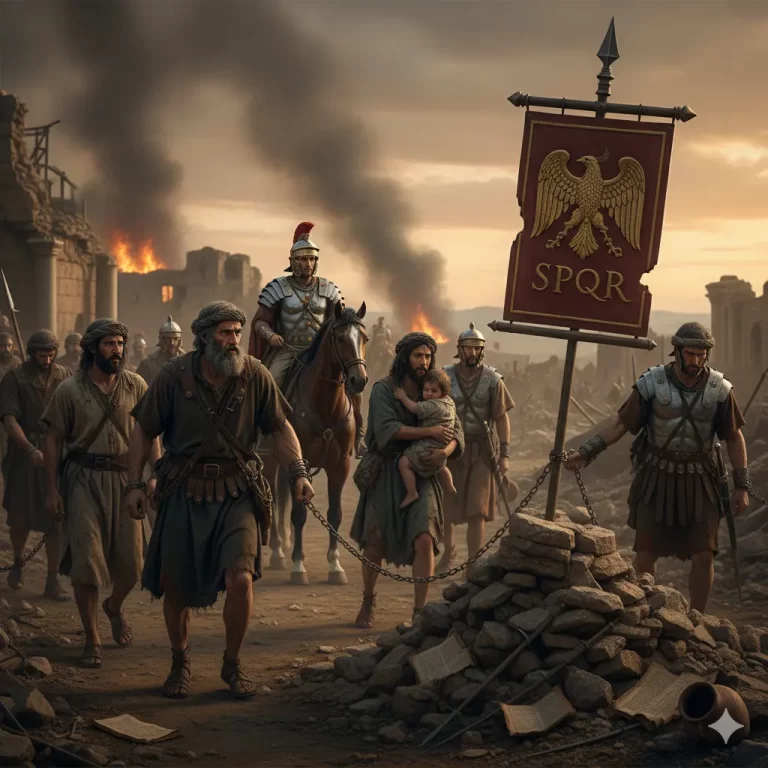
By the 2nd century CE, Judea had become a volatile province under Roman control. When Emperor Hadrian banned Jewish religious practices, Simon Bar Kokhba led a widespread revolt, forming a short-lived independent state.

The Roman reaction was ruthless and quick. Judea was destroyed by the legions’ defeat of the revolts and those who survived were sent into flight. Captured Roman weapons, the identical ones discovered today, were stored in caves that served as hideouts and armories around the Dead Sea.

These swords likely belonged to Roman soldiers stationed in Judea and were seized in combat before being concealed by rebels. Their remarkable preservation is not just archaeological luck — it’s a message from history, frozen in iron and leather.

Roman Swords

Archaeological Significance: Technology, Supply, and Craftsmanship

These discoveries are extremely valuable from an academic viewpoint. Roman weapons‘ iron content provides information on roman metalworking, trade routes, and military planning.

Researchers are identifying production procedures employed in centralized weapon factories with the aid of modern tools such as 3D scanning and X-ray fluorescence (XRF). This displays the efficient distribution, mass production, and standardization of Weapons throughout the territory, a logistical achievement unmatched in history.

What the Roman Weapons Reveal About Warfare

The discovery helps historians decode the evolution of Roman military strategy:

  1. Tactical Transition: The switch from gladius to Roman Spatha illustrates Rome’s progress toward warfare that is more flexible and centered around horses.

  2. Cultural Exchange: The adoption of Roman weapons by Jewish rebels is an example of how conqueror and defeated cultures can share technology.

Discipline and Hierarchy: The different division of Roman military ranks according to weapon type highlights Rome’s unmatched organizational complexity.

The Symbolism: From Imperial Power to Archaeological Treasure

These Roman swords are used for purposes other than warfare nowadays. They are artifacts of ambition, discipline, and defiance. For Rome, they symbolized order and conquest; for Jewish rebels, they represented survival and resistance.


Their continued existence over thousands of years serves as a reminder of how fascinated people have always been by Roman weapons, which were once used to establish empires and define cultures.

Conclusion: The Legacy of the Roman Spatha and the Spirit of Rebellion

The four Roman Swords discovered near the Dead Sea aren’t just remnants of warfare — they’re tangible links to the story of empire, rebellion, and resilience. Each blade reflects the craftsmanship of Rome’s weapon makers and the courage of those who wielded or defied them.

These weapons have the potential to change our perception of Roman military ranks, battlefield hierarchy, and the developing art of combat in history as they are preserved and shown.

From the hands of soldiers to the depths of the desert, the Roman Spatha continues to tell a story — not of defeat, but of dedication.

Key Takeaways

  • Four Roman swords unearthed near the Dead Sea remain remarkably preserved.

  • They offer insights into Roman Weapons, craftsmanship, and military organization.

  • The find connects directly to the Bar Kokhba Revolt and the Jewish struggle against Roman rule.

  • Each sword reveals how Roman Military Ranks used weapons by role and status.

  • The Roman Spatha is evidence of Rome’s strategic development and worldwide sway.

What Would You Carry in a Roman Legion?

From the gladius of legionaries to the longer spatha used by cavalry, each weapon reflected rank, discipline, and battlefield strategy. Understanding these tools helps bring Roman military history to life.


Compare historically inspired Roman weapons and discover which design fits your interest, collection, or reenactment goals.


👉 Explore our ancient warfare collections and build your own Roman arsenal.