
Wilkinson Sword: What We Learn From the Legends
In the realm of edged weapons, bladesmithing, and historical armament, few names evoke as much respect, legacy, and technical gravitas as Wilkinson Sword. Over centuries, wilkinson sword evolved from a gunsmith’s workshop to a gold-standard sword maker through precise sword manufacturing; its traditions, methods, and commitments remain instructive to any artisan seeking historical authenticity and uncompromising quality. In this article, we trace Wilkinson’s journey from its 18th-century roots in firearm production, through its transition into sword-making, to its innovations like blade testing and then draw out practical principles modern crafts-people can adopt to elevate their own work.
A. The Legacy of Wilkinson Why Their Methods Still Matter
From Gunsmithing Origins to Sword Production
Wilkinson’s roots trace back to 1772, when Henry Nock established a gunsmith business in London. Initially focusing on firearm components and weapons, Nock’s firm quickly gained repute, supplying arms including volley guns and bayonets to naval and military contracts.contracts. Wikipedia+2
After Nock’s death in 1804, control passed to his foreman and son-in-law, James Wilkinson, who continued the business under royal warrant, further reinforcing its high-end clientele among military and aristocratic circles.
By 1824 (or soon after), James’s son Henry Wilkinson stepped in and steered the company toward sword production transforming a renowned firearms workshop into a sword-making house. Over time, by 1891 the firm became formally known as “Wilkinson Sword.”
This transformation marked not merely a shift in product, but a redefinition of identity from gunsmithing to the art and science of bladesmithing. The value lay in embracing sword manufacturing as a specialized craft, not a side-line, investing resources, skill, and institutional commitment into producing superior edged weapons.
Crafting Distinction: In-House Production & Holistic Control
What set Wilkinson apart wasn’t just making swords it was how they made them. From forging blades to crafting hilts and assembling finished swords, virtually every step remained under Wilkinson’s roof. They refused to fragment production via outsourcing. This holistic, in-house integration ensured uniform standards, consistent quality, and mastery over every element from metal to final fitting.
Such full-control over production allowed Wilkinson sword to enforce their own standards: when you handle the forging, tempering, shaping, hilting, finishing and final proofing you also own responsibility and accountability. This integrity of process meant that every sword was a product of coherent craftsmanship, not a patchwork assembled from disparate suppliers.
Innovation in Quality Assurance: The Eprouvette Testing Machine
Craftsmanship alone was not enough. In 1844, Henry Wilkinson brought a novel innovation to the swords-world: the “Eprouvette” sword-testing machine.This device was designed to subject each blade to extreme stress simulating the kind of force encountered in real combat. The goal was to ensure that no sword leaving their factory would fail under harsh conditions.
For Wilkinson, a sword was not a decorative piece or a dress accessory it was a functional weapon. To treat it otherwise was irresponsible. The Eprouvette applied impact and deflection tests far beyond typical wear, mimicking brutal battlefield strikes. Only blades that survived were stamped “proved” a rigorous assurance of reliability.
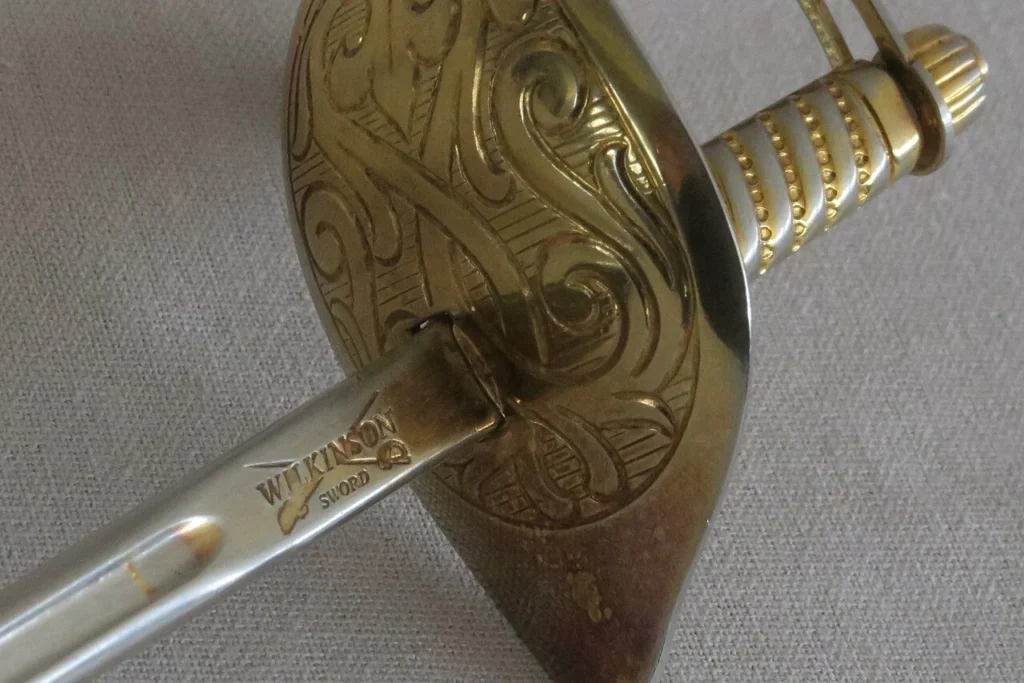
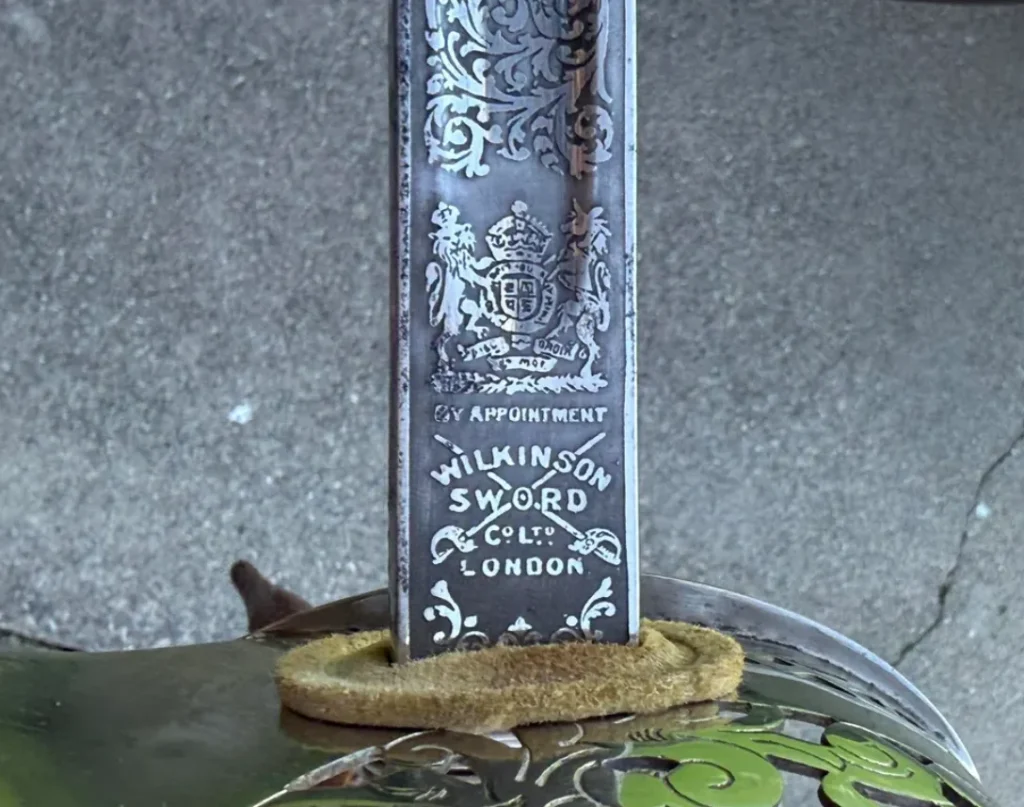
This proof-testing was backed by visible proof marks typically a gilt-brass (or similar alloy) disc inset into the blade’s ricasso, often with engraved insignia (such as a six-pointed starburst) and, for top-grade blades, a serial number etched along the spine for traceability.
These marks were more than branding they were a public, verifiable stamp of quality, a guarantee that what you held in hand had passed rigorous examination and was battle-worthy.
Reputation, Royal Warrants, and Enduring Recognition
Wilkinson’s uncompromising standards, proven reliability, and integrated craftsmanship earned them respect, prestige, and high-profile clients. Wilkinson Sword secured royal appointments and supplied high-level military equipment across Britain and beyond.
By the 19th and 20th centuries, Wilkinson sword had become synonymous with high-quality, reliable military and ceremonial swords blades that blended tradition, robust performance, and heritage. Even as global conflicts evolved, and firearms overshadowed swords in practical combat, Wilkinson’s swords remained revered both among military officers and collectors.
Their reputation became a benchmark. For many, a sword bearing Wilkinson’s proof disc and serial number was more than metal it was assurance, honor, and legacy.
B. What We (Modern Craftsmen) Take From That Legacy
Reflecting on Wilkinson’s history yields powerful lessons — especially for artisanal creators of historical gear, re-enactment weapons, leather-and-wood goods, or any handcrafted item where authenticity, durability, and integrity matter.
1. Craftsmanship over shortcuts: owning the process end-to-end
Wilkinson’s refusal to outsource core elements forging, tempering, hilt-fitting, finishing preserved their control over quality and consistency. Modern artisans can replicate this discipline: when possible, manufacture core components in-house (blade forging, joinery, forging, leather work) rather than sourcing them externally. This end-to-end control helps ensure consistency, uphold standard, and protect brand integrity in sword manufacturing and similar crafts.
Dependence on external suppliers might offer convenience or lower upfront cost but often at the expense of uniform quality. Craftsmanship thrives when makers own every step from raw material to final finish.
2. Rigorous testing & quality assurance build reliability, not just aesthetics
The Eprouvette was more than showmanship it was a statement that blades should be reliable. For craftsmen today, that means subjecting finished work to real-use stress testing. For example: checking structural integrity under flex, pressure, edge-holding, material fatigue; simulating wear and tear; examining joints, fittings, and materials under stress.
This testing culture even if scaled down builds credibility. It ensures the product isn’t just decorative, but capable under real conditions: whether for reenactment, cosplay fight, display, or daily handling.
3. Transparency, traceability, and provenance as trust mechanisms
Wilkinsons sword proof disc and serial number weren’t just decorative they provided traceability. A buyer could verify a blade’s origin, testing history, and even cross-check with company records.
For modern makers and sellers, transparency in materials (steel grade, leather type, wood origin), processes (forging method, tempering, finishing), and provenance (when, where, how made) builds trust especially among discerning collectors, reenactors, or B2B clients. A “build sheet” or item history adds perceived value beyond aesthetic.
4. Heritage, authenticity & storytelling as differentiators
Wilkinson didn’t sell just swords(Wilkinson sword) they sold confidence, history, and heritage. Each sword told a story: of craftsmanship, testing, lineage. For artisans working in medieval gear, historical reenactment props, or heritage-style leather and wood goods, embracing tradition, historical techniques, and authentic materials adds unique value.
In a world crowded with mass-produced, cheap replicas, authenticity and heritage become powerful differentiators driving preference among clients who appreciate realism, artistry, and historical fidelity.
5. Durability and reliability gear built for real use, not just display
Because Wilkinson tested blades, their swords could withstand actual use not just ceremonial wear. Translating that to modern gear: build for durability, not just looks. Whether it’s a cosplay sword, a reenactment axe, leather armor, or wooden shield design and build for strength, wear-resistance, realistic handling.
This ensures that products including sword manufacturing outputs aren’t fragile showpieces but functional, long lasting items that build long-term value and reputation.
C. Applying the Legacy: What It Means for Today
By embracing Wilkinson-inspired standards and mindset, modern artisans can produce work that stands out on craftsmanship, authenticity, usability, and trust. Here are concrete advantages and outcomes of such commitment:
Superior real-world durability and reliability: Items subjected to internal quality control and stress testing are more likely to survive repeated use whether in reenactments, cosplay, transport, display, or storage. This reduces returns, increases client satisfaction, and builds confidence in your offerings.
Authentic craftsmanship and heritage feel: Products infused with historical techniques, traditional materials, and documented process carry a sense of legacy. Clients who value realism and authenticity will prefer these over cheap mass-produced replicas.
Client trust through transparency: By offering detailed specifications material grades, production steps, testing protocols you demonstrate accountability and integrity. For B2B clients, sellers, or history-conscious buyers, this transparency becomes a competitive differentiator.
Market differentiation and niche positioning: In a saturated market of costume props and replicas, handmade, quality-assured, historically grounded gear occupies a premium niche. You then serve not just as supplier, but as curator of heritage-grade equipment.
Brand legitimacy and long-term respect: Consistent output of high-quality, tested, transparent, authentic products builds reputation over time akin to how Wilkinson earned royal warrants and elite clientele. That reputation attracts serious enthusiasts, collectors, and institutions not just casual hobbyists.
Reduced liability and improved credibility: By testing gear, documenting strength and quality, you minimize risk of failure, misrepresentation, or disappointment. For buyers expecting functional gear (not just display pieces), this builds confidence and reduces negative feedback.
Adopting a Wilkinson-inspired model aligns with values of craft, history, integrity, and quality essential for artisans, small manufacturers, or niche sellers in historical gear, armor, weapons, or handcrafted goods. This approach encourages makers especially in sword manufacturing and historical gear to elevate standards across their entire production lifecycle.
Conclusion: Legacy Is More Than a Name
The story of Wilkinson Sword teaches that quality isn’t accidental. It’s built on discipline, integrated craftsmanship, honest testing, and pride in heritage. A blade isn’t just metal it’s confidence, trust, and legacy.
When modern craftsmen whether forging swords, crafting reenactment gear, designing leather armor, or managing sword manufacturing, they offer more than a product: they provide trust, authenticity, and heritage.
Principles to internalize:
Prioritize in-house craftsmanship own every step of production.
Embed rigorous quality testing ensure durability, not just appearance.
Maintain transparency and traceability materials, methods, provenance.
Offer authenticity and heritage embrace historical techniques and integrity.
Build for real-world reliability gear that lasts, not just decorates.
Experience Craftsmanship Built on Proven Standards
The legacy of Wilkinson reminds us that true quality is measured in process, testing, and trust—not appearance alone. At Doon Handicrafts, we apply similar principles of in-house production, research-driven design, and rigorous quality control to create historically inspired weapons that balance authenticity, durability, and precision.
Explore our collections and discover swords, armor, and heritage gear designed for collectors, reenactors, and serious enthusiasts who value reliability as much as aesthetics.
 Browse our premium craftsmanship collections and experience the difference of tested quality.